

Many people know JINS as Japan’s best‑selling eyewear brand.
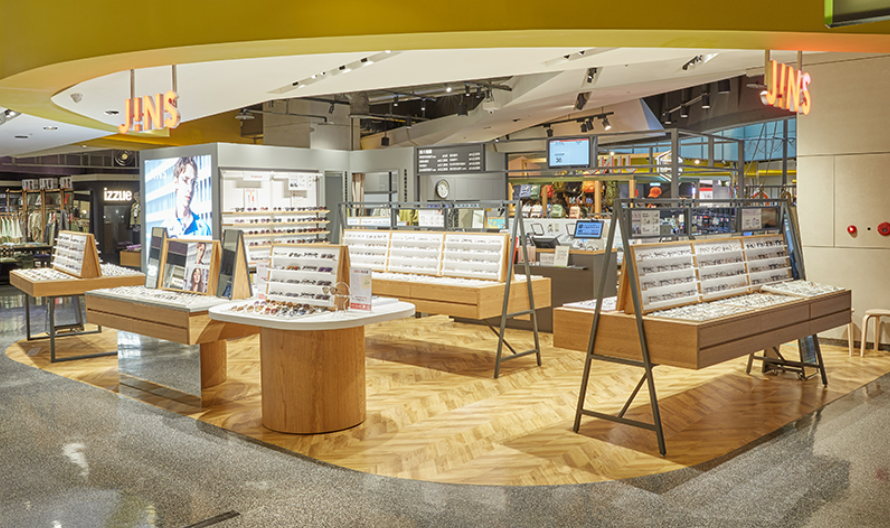
But when you actually walk into a JINS store, you’ll find that they sell far more than just a pair of glasses.
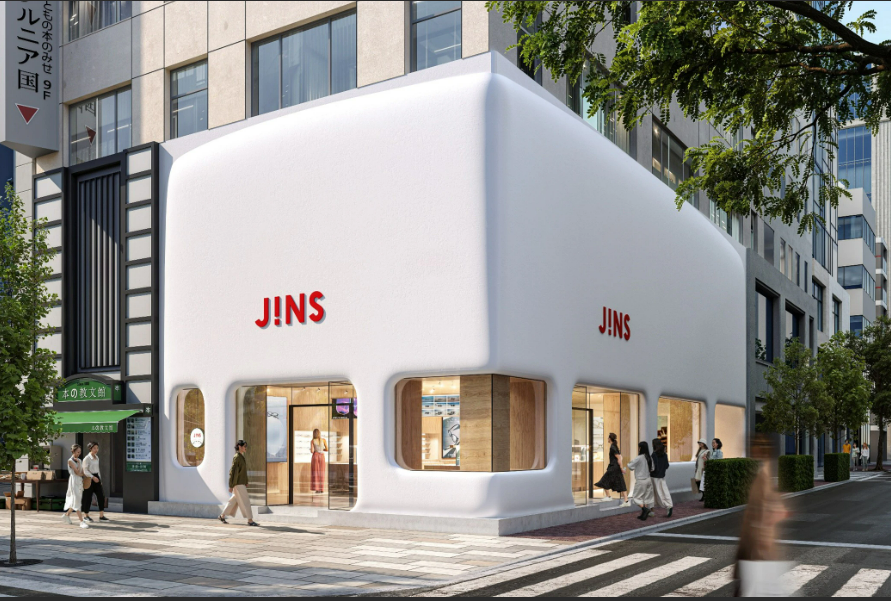
In March 2026, JINS opened its first global flagship store in Tokyo’s Ginza district. People come from around the world not only to get glasses but also to admire the architecture, designed by renowned architect Sou Fujimoto. On social media, “JINS Ginza Store” has become a popular photo spot, right up there with teamLab.
What makes an eyewear store so special?
Today, let’s look at JINS from a different angle — how it has transformed from “a place to buy glasses” into a unique cultural experience.
It Started with a ¥3,000 Pair of Glasses: The Disruptor’s Origin
JINS’s story begins with founder Hitoshi Tanaka on a trip to South Korea.
At the time, the average price of glasses in Japan was easily over ¥10,000. While in Korea, Tanaka bought a pair of glasses for just ¥3,000 (about one‑tenth of Japan’s typical price). He kept thinking: “Could we sell affordable glasses in Japan? And beyond low prices, what other value could we offer?” So Tanaka — who had perfect vision and had never worn glasses — plunged into the eyewear industry.
JINS’s innovations go far beyond pricing. They redefined glasses as “eyewear” — clothes for the eyes — rather than just medical devices. Then came the ALL‑IN‑ONE PRICE model, the ultra‑light Airframe series, and the world’s first blue‑light‑blocking glasses, JINS SCREEN. Each launch shook the industry.
A revealing detail: Inside JINS, there’s an unofficial culture — whenever someone proposes a new idea, others ask not “What could go wrong?” but “How can we make this work?” From the president’s “Let’s give it a try” attitude to the execution teams, JINS’s DNA is built on breaking the rules.
The “Hidden Menu” Behind 30‑Minute Service
Many tourists visiting Japan add “get a pair of JINS glasses” to their must‑do list. The reasons are clear: transparent pricing, efficient service, and glasses ready in as little as 30 minutes.
But what really delights customers is the “hidden menu” JINS prepares during that 30‑minute wait.
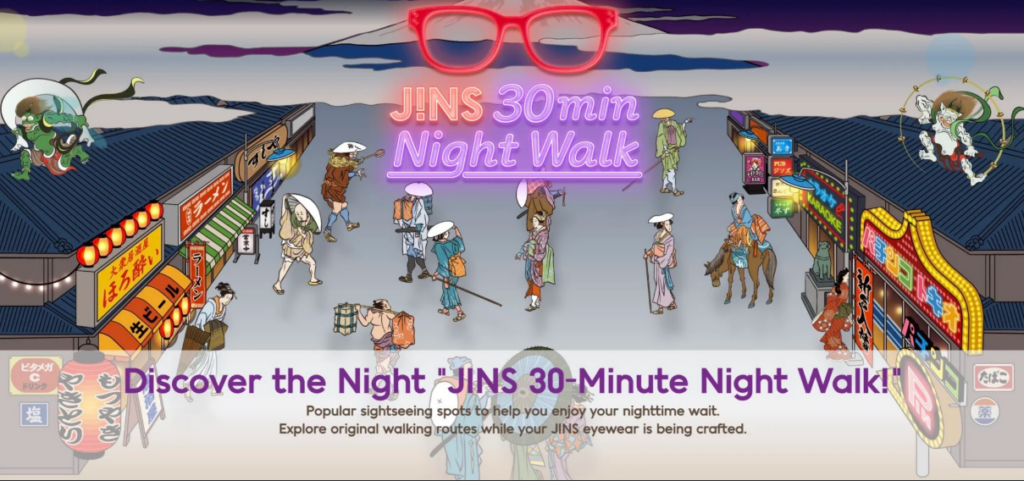
To keep customers from getting bored, JINS Japan launched the “JINS 30‑minute Night Walk” program. Each store has a recommended walking route around the neighborhood — from the modern Japanese architecture of the Kyoto Teramachi‑dori store to the shopping landmarks near the Ginza Loft store. JINS turns waiting time into a mini urban adventure.
When you return, your glasses are ready. You also receive a specially designed illustrated lens cloth — it’s not just a cloth; it also serves as a discount coupon for nearby partner shops. A map, a cloth, a pair of glasses — with these small touches, JINS tells you: We don’t waste your 30 minutes.
Ginza Flagship: How an Eyewear Store Becomes a City Landmark
In March 2026, JINS opened its first global flagship store on Chuo‑dori in Tokyo’s Ginza district. The location alone is telling — Ginza is prime territory for luxury brands. Yet JINS not only secured a prime spot but also enlisted architect Sou Fujimoto to design the building.
The facade is wrapped in soft white, reminiscent of Japanese sweets and washi paper — honoring the building’s history while expressing a new kind of “Wa” (Japanese) aesthetic. Even more unique: crushed lens fragments are mixed into the exterior wall material, polished to a delicate, handmade texture — a subtle metaphor for “eyewear” itself.
Inside, a five‑meter‑high sculpture, Snow Deer by Kohei Nawa, is permanently displayed in the atrium that extends from the first floor to the basement level. The basement houses the brand’s first gallery space, with its inaugural exhibition created in collaboration with the ikebana school Ikenobo. Even the staff uniforms were designed by CFCL, the brand known for designing uniforms for the 21st Century Museum of Contemporary Art, Kanazawa.
Rooted in the Japanese concept of en (fate or connection), the store aims to offer new discoveries every time you visit. An eyewear store, transformed into both an art gallery and an urban living room.
More Than Selling Glasses: A Company with Social Conscience
If the stores are JINS’s “public face,” its commitment to society is the “backbone” that supports everything.
JINS was born in Maebashi, Gunma Prefecture. When Hitoshi Tanaka saw his hometown’s commercial district declining, he didn’t just write a check. Instead, he spent 12 years — together with architects and artists — transforming a 300‑year‑old traditional inn into a “city living room” that revitalized community spirit. This “Maebashi Model” of regional regeneration has even drawn visits from former Prime Minister Shigeru Ishiba to study its success.
In the field of assistive technology, JINS is equally admirable. In 2015, JINS developed the JINS MEME wearable device that tracks eye and body movements. During development, the company received heartfelt requests from people with disabilities and their families: “We wish JINS MEME could work as a computer mouse.” So in 2025, JINS released JINS ASSIST — an assistive device that lets users control a computer mouse simply by moving their head. Using the technology they know best, JINS is making a real effort to bridge the digital divide.
🏁 Final Thoughts
To many, JINS is just an affordable eyewear chain. But when you look closer, you’ll see it’s so much more.
From the industry‑disrupting ¥3,000 glasses to the thoughtful 30‑minute service program; from the architectural statement and social experiment of the Ginza flagship to assistive technology like JINS ASSIST — JINS has never been just about selling glasses. It’s using its unique brand language to redefine what an eyewear store can be.
Next time you step into a JINS store, take a few extra minutes. You might just discover that they really do sell more than just a pair of glasses.